Farrier Tom Broadbridge has overseen the care of numerous barefoot horses – here’s what he has learned
Considering transitioning your horse to barefoot, but not sure how to go about it? Spend any amount of time on social media and you’ll soon find that barefoot trimming and everything surrounding it is a hot topic.
“To my mind, enabling the horse to go barefoot is the gold standard,” says Tom Broadbridge, who qualified as a farrier in 2003 and is now purely a barefoot hoofcare professional.
“There are times when a horse can’t immediately go completely barefoot. Sometimes horses that look sound with shoes on may not be free from inflammation. Consequently, their unsoundness may be more obvious when the shoes are removed.
“If a horse is not sound, they may need another form of hoof protection after removing the shoes, such as hoof boots. In such cases, immediately going completely barefoot may not be best.”
Tom advises against making the transition alone.
“Firstly, ensure you’ve built a strong team of equine professionals around you. Communication with them is key.
“Speak to your vet and your hoof care professional for their advice rather than plunging straight into taking the shoes off.”
Why transition a horse to barefoot?
Keeping horses naturally is a significant motivator in the transition from shod to barefoot. There are several other reasons owners make the change too, including:
1. Cost
With the cost-of-living crisis applying increasing financial pressures – and leaving some owners unable to make ends meet – the thought of ditching a large six-weekly bill appeals to many. However, Tom advises proceeding with caution.
“If finances are your only motivation, I’d advise you to think again,” he says. “Barefoot is not necessarily the easy or cheap option. Keeping a barefoot horse requires a holistic approach, and you may find mounting costs with equine professionals in other areas of your horse’s management to address soundness without shoes, as they may mask lameness.”
2. Performance
“A horse often gains a more natural movement without the restriction of steel shoes,” explains Tom. “Watch the horses in the dressage arena that are barefoot.”
3. Retirement or semi-retirement
Many owners reassess their horses’ lifestyle when they reduce or remove their ridden routine. As well as removing shoes, many opt for 24/7 turnout or retirement livery, too.
4. Eliminates shoe pulling
If you have a horse that regularly pulls shoes, this leads to frequent call-outs mid-shoeing cycle and risks damage to the hoof.
5. A last resort
“I specialised in remedial farriery years ago and thought it was the key to everything,” explains Tom. “Then, you’d have cases where you’d throw every specialised shoe and technique you knew to fix a lame horse, but nothing would work.
“One client sent their horse to a barefoot rehab yard, and the horse came sound. It was one of the most exciting moments of my career. In fact, it was the beginning of my transition to barefoot.”
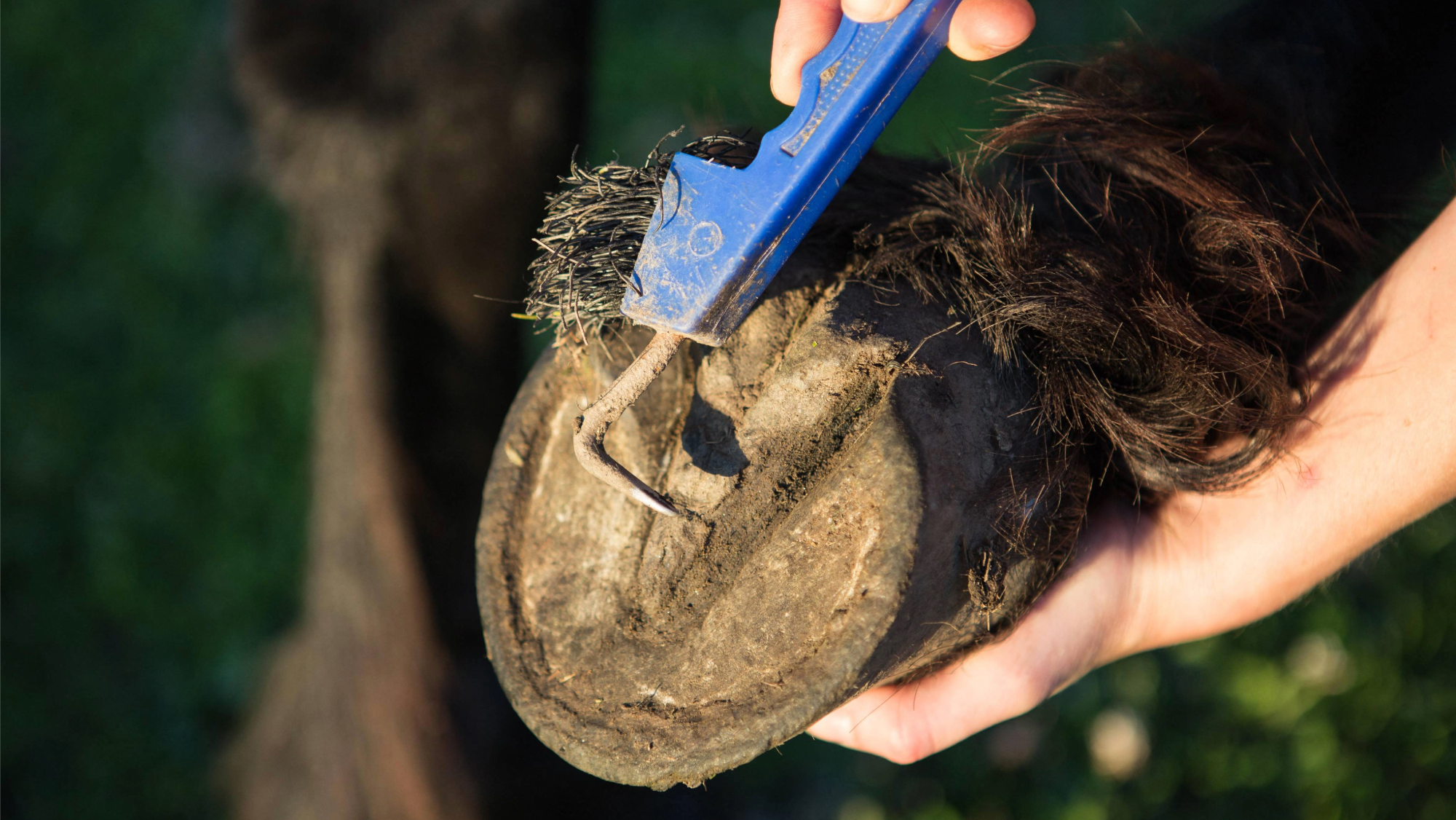
You may need something sharper than a hoof pick to remove debris from the white line. Photo: Alamy
How to transition a horse to barefoot
Consulting your hoofcare professional alongside your vet and an independent nutritionist is the best way to set your horse up for a successful barefoot life.
That said, there’s much you can do in the months ahead to ease the transition.
Feeding
Ideally consulting with an independent nutritionist, Tom recommends reviewing and reducing the amount of sugar in your horse’s diet, from bucket to haynet.
“Sugar is a focus point because it is so influential in terms of inflammation,” says Tom. “But an independent nutritionist can help you review the micronutrients your horse is receiving for overall health and ensure they are optimally fed, too.”
Workload
“If I decided to take off my trainers and immediately go for a 20-mile walk, my feet would be in a sorry state,” says Tom. “It can be the same with newly-barefoot horses.”
While some individuals adapt quickly to work on hard or stony surfaces, others need time to adjust. Tom advises looking over your horse’s workload, scaling back for a period, then building up to your usual routine.
“Groundwork can be a great place to start,” adds Tom.
“If you’ve ever walked on uneven tarmac with no shoes, you’ll know how unpleasant it can feel and the effect on your gait.
“Now carry a saddle and a person. You’ve made an uncomfortable task even more difficult.”
All at once?
If a horse is shod all round, some owners choose to remove the back shoes first.
“The front feet carry about two-thirds of a horse’s weight,” says Tom. “Some owners like to remove the hind shoes first to allow the horse to adjust how he loads and potentially ease the transition.”
However, others may argue that there is a height differential between the shod and barefoot hooves, and that can cause unintended issues.
How to support a horse while transitioning to barefoot
Tom says it’s perfectly normal for newly barefoot horses to feel sensitive on stony ground.
“Anyone who was used to wearing shoes would be,” he says.
“However, if a barefoot horse appears lame on any surface, it is a cause for concern and action needs to be taken.”
Always gain advice from a qualified equine professional.
If you regularly walk your horse on a hard, uneven track – for example, to reach his paddock – hoof boots are a useful tool.
Tom, who designs and produces his own range of hoof boots, says it helps avoid the cumulative effect of contact with sub-optimal ground.
“Newly barefoot horses who walk on stones might develop slight bruising.
“This might be pretty inconsequential as a one-off, but if it’s a daily thing you get bruising forming on top of bruising, and that can become very sore. What’s more, it can cause inflammation and affect the rest of the body due to compensatory issues.
“Using hoof boots for any activity on surfaces, such as stony tracks, can reduce issues, especially in those early stages, by protecting your horse’s soles.
“Gradually introducing different surfaces when the horse is completely barefoot allows them to adjust, and improves hoof health over time.”
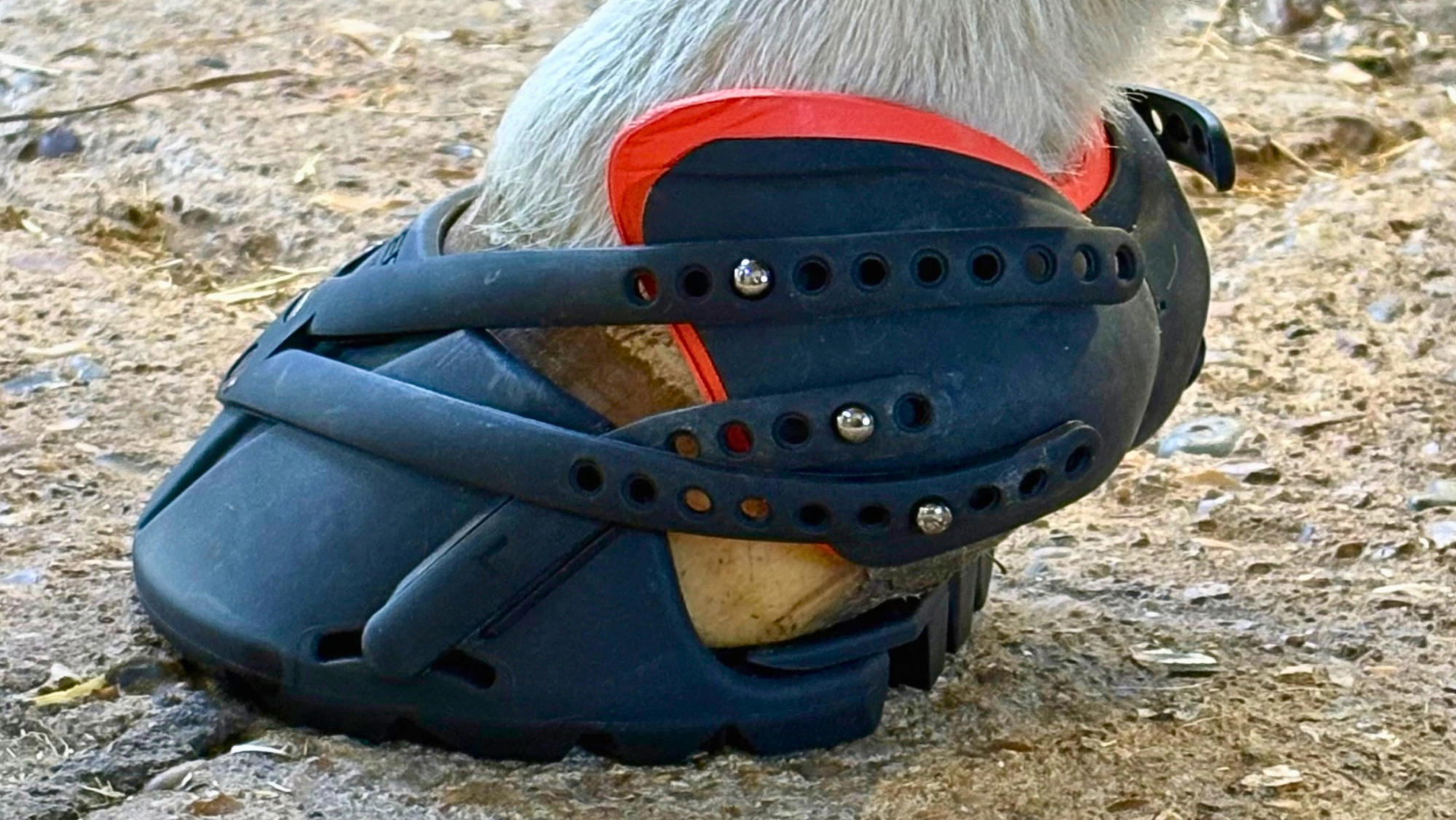
Hoof boots like these Pioneer ones help horses transition to barefoot and support hooves through work. Photo: Tom Broadbridge
Choosing and fitting hoof boots
You can find many different hoof boot styles on the market, including Tom’s own design, Pioneer Sports hoof boots, which are a self-adjusting style to accommodate natural movement and a growing hoof throughout the trim cycle.
Each company has its own fitting and measurement guidelines.
Tom recommends consulting your hoofcare professional on a style and fit to suit your horse when seeking hoof boot advice.
“Some companies, like The Hoof Boutique, will give you advice based on images and measurements you send them or provide a fit kit.”
Dealing with hoof cracks
When transitioning a horse from shod to barefoot, hoof wall cracks or wall degradation are common.
“If your horse has been shod for quite some time, you’ll have a series of nail holes,” Tom explains.
“Here, the horn is weak and will break away.”
Always seek advice from the hoof care professional. Many riders reach for hoof conditioners and moisturisers, but Tom advises it is bacterial or fungal infection within the hoof wall, not dryness, that causes low-level cracking.
“Use an anti-bacterial and anti-fungal product on the hoof horn from about a centimetre below the coronary band,” he suggests. “This permeates the horn and tackles the infection.
“New growth is imbued with the treatment and the cracking should stop. You can actually smell the product when you trim the hoof.”
He adds that the white line can stretch due to flaring, meaning small stones and other debris become lodged within.
“You need a tool sharper and thinner than a hoof pick, such as a bradle, to gently clear it,” advises Tom.
“I’d then use a packing material [like this one] to preserve the white line.”
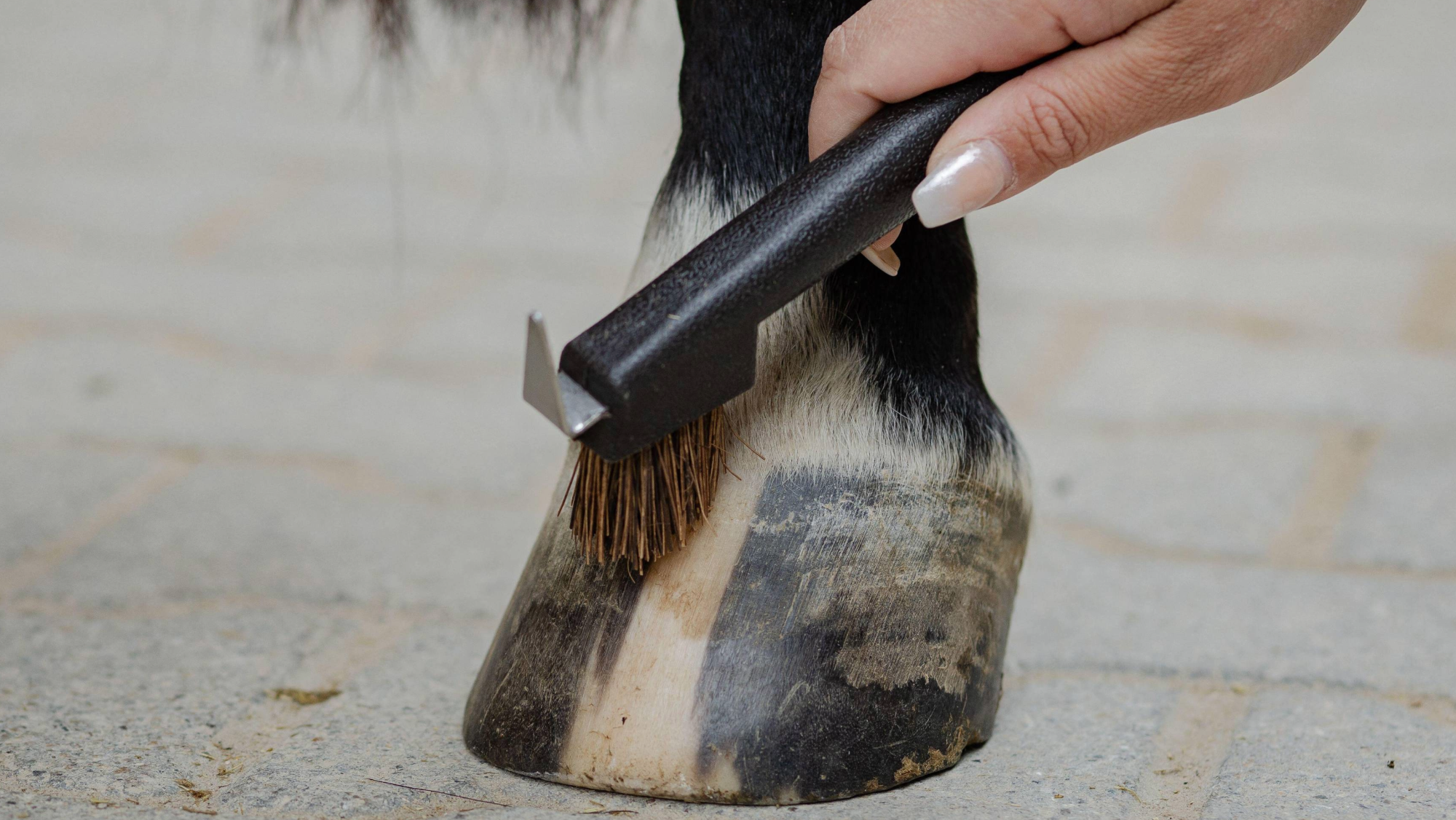
A toothbrush or a hoof pick brush like this one is ideal for applying an anti-bacterial treatment. Photo: Alamy
What’s the best time of year to transition a horse to barefoot?
For Tom, there are pros and cons to a summer versus a winter transition.
“If you transition in the winter, the ground is generally softer, but so are the feet,” he says. “So, the sole is more vulnerable to bruising and potentially more sensitive to stony underfooting.
“In the summer, the feet are generally harder and the sole less flexible, but also the ground is also harder and possibly more uncomfortable underfoot.”
The time of year you choose to transition will depend on what you already know about your horse’s feet. Ultimately, Tom recommends avoiding spring and autumn when the grass flushes and its sugar content intensifies.
“At these points in the year there’s a real boost of energy and sugar in the grass,” Tom explains. “This causes an instant response in the body that might lead to inflammation. It doesn’t need to be as severe as acute laminitis – even a small amount of inflammation in the body can make horses more sensitive.
“My horse has been barefoot for nine years. When the weather changes and the grass shoots up, he’ll feel the odd stone here and there where he wouldn’t have a couple of weeks before.
“And he’s not transitioning – he’s well into barefoot life.”
Ultimately, success will come from strategising ahead of removing your horse’s shoes.
“Start planning your transition while your horse is still shod,” says Tom. “Making dietary adjustments in advance, for example, can help minimise soreness, maintain hoof wall integrity and altogether make the transition far smoother.”
- For unlimited access to advice on how best to care for your horse, subscribe to the Horse & Hound website
You might also like:
Hoof boots: what they’re for, who they suit, and how to get the fit right

Choose a pair of the best hoof boots so you can saddle up and go exploring
No foot, no horse – hoof supplements to help maintain healthy hooves
How long should you be soaking hay for horses? An expert explains

Subscribe to Horse & Hound magazine today – and enjoy unlimited website access all year round