Carl Hester shares his views on the importance of the give-and-retake in dressage and the need for collective marks
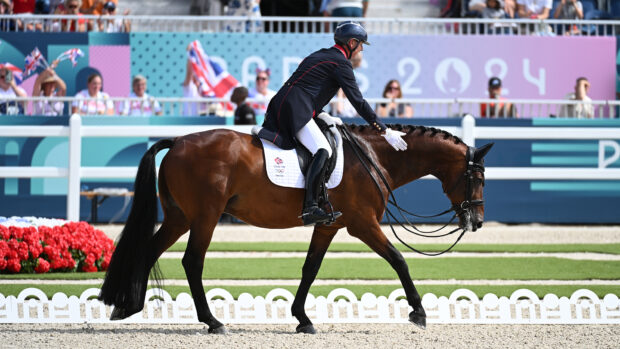
Some 18 months ago, I wrote about introducing give-and-retake of the reins at small tour and grand prix level – an idea that came out of a conversation with Kyra Kyrklund.
That initiative gained great support at the FEI General Assembly last year, tabled under “changes in the rules that cannot await because of their impact on the welfare of the horses or the safety of the athletes”.
I advised anyone who doesn’t already incorporate give-and-retake in their training to start practising – it should be part of everyone’s routine.
At the recent FEI Sports Forum in Lausanne at the end of March – where it was reported that stretching on a long rein was recently trialled at a test event at Warendorf, Germany – it was discussed again as “being worked on”.
What I hope is achievable is a guideline as to what amount of stretch is expected and acceptable. My opinion is that horses stretch a lot better in rising trot, so I hope that whether to sit or rise will be left to riders.
Of course, these matters have to be trialled and worked out properly, but all I can say at this stage is that the FEI seems to be moving at a collected walk rather than an extended canter on things that “cannot wait”!
Collective marks
The 2017 FEI General Assembly voted in favour of the Dressage Judging Working Group’s proposal to remove the collective marks for paces, impulsion and submission and replace them with a single collective mark for the rider’s position, seat, correctness and effect of the aids.
There was an outcry, with German team trainer Monica Theodorescu and German five-star judge Dr Dietrich Plewa in particular producing very valid reasoning in opposition.
As Monica said at the time: “The collectives are essential to highlight the value of the principles of dressage. The judge gets the opportunity to weigh the rider’s focus positively or negatively, the clarity of gaits, throughness, connection, activity from behind and much more.
“I hope that because of this change we won’t return to seeing horses who are not loose, nor relaxed and lack natural expression.”
Dr Dietrich Plewa – who retired in 2019 – admitted at the time that judges had used collectives to influence the overall score but made some pertinent points, particularly about the marks for paces and for submission.
On the paces mark, he said: “When a horse shows mistakes in the rhythm in the test, which are not enough to eliminate the horse, then we could have expressed our remarks on balance and clarity in that collective mark.” Makes sense to me.
While some argued that the collective qualities should be addressed in the mark for each movement, collectives for paces and submission – but let’s call that something else, please – play a valuable role, it’s hoped they will be reinstated after consultation.
After all, if a rider sits perfectly for a nine yet the horse has its mouth open or tongue out, that does not make sense and does nothing to promote harmony in our sport.
Sunshine time
With the recent change to decent weather and a bit of sunshine, it’s fantastic that all the horses are able to get much more turnout. The difference in their bodies after several months of limited turnout is incredible to feel. It just validates the reasoning for turning out. I can feel the difference in them almost immediately, not just physically, but mentally, too.
Finally, while it was sad to see so few high-class entries at the World Cup Final in Texas – it seems people don’t want to travel these distances in the current climate – our Becky Moody took the plunge, and what a decision it proved to be, with her and Jagerbomb taking the title. Congratulations to them both – it’s thoroughly deserved.
● How do you think the reintroduction of collective marks would change dressage judging – for better or worse? We’d love to hear from you at hhletters@futurenet.com, including your name, nearest town and county, for the chance to have your thoughts published in a future issue of Horse & Hound magazine
- To stay up to date with all the breaking news from major events, as well as exclusive insights from top names, subscribe to the Horse & Hound website
You might also enjoy reading:

‘What are we waiting for?’ asks Carl Hester following the FEI General Assembly

Improve your dressage scores: how and why to ride a give and retake of the reins
5 places most riders lose marks in the dressage arena (and how to win them back)

Subscribe to Horse & Hound magazine today – and enjoy unlimited website access all year round