Equine breeding season occurs in the spring and summer. It is during this time that mares go into recurring cycles of oestrus, giving a window of approximately five to seven days in roughly every 21 days in which a mare is “in season”.
Breeding a mare takes careful preparation and precision, with plenty to work out in advance. From choosing a stallion and selecting a broodmare to working out how much it costs to breed a horse, a healthy amount of research should go into your decision.
When are mares in season?
Mares are seasonally polyoestrus, which means they recurrently come into season at a particular time of year. Generally speaking, a mare’s breeding cycles take place between April and October. However, this – and cycle length – can vary horse to horse.
In winter, a mare’s reproductive system goes into a rest period, known as anoestrus. After this winter inactivity, the cycle usually begins again in spring.
The mare does not suddenly begin to cycle regularly, but has a “transitional phase” when the length is variable. Once the mare is truly in the breeding season, her oestrus cycles last around 21 days.
Equine breeding season – understanding the oestrus cycle
Most mares have a 21-day oestrous (breeding) cycle. This is divided into:
- Oestrus (average five to seven days)
- Dioestrus (14–16 days)
The cycles begin at puberty (approximately 18–24 months) and continue throughout the mare’s life.
Oestrus
During this time, the mare is receptive to the stallion. Typical signs of oestrus include:
- Adopting a urinating stance, raising the tail raised and uritinating in small squirts
- Opening and closing the vulval lips, known as “winking”
During this time one or more ovarian follicles enlarge and burst, releasing an egg. This is ovulation.
The mare normally ovulates approximately 24 hours before the end of oestrus, and its exact timing is only determined by performing ultrasound scans of the ovaries.
Dioestrus
The mare’s receptiveness ends and she may flatten her ears, swish her tail or squeal/kick out at the stallion.
How long is a mare pregnant for?
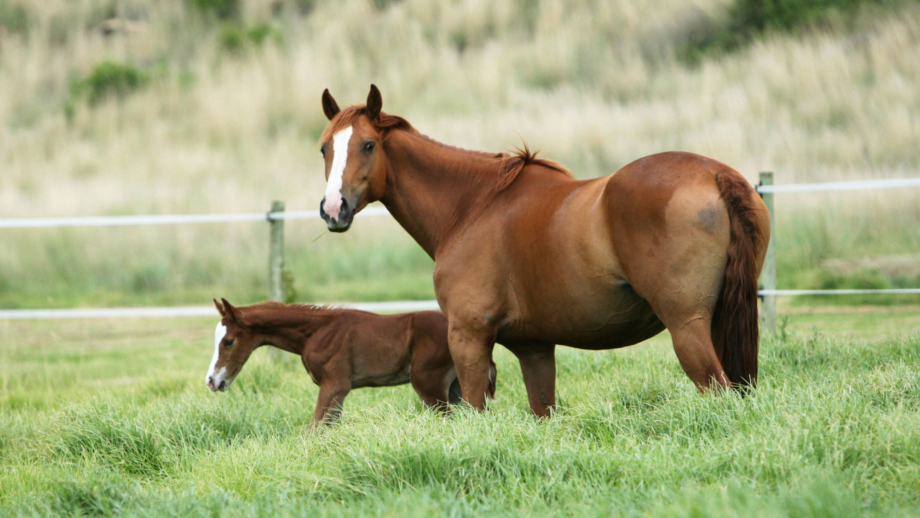
If breeding is successful, mares are pregnant for about 11 months, though a gestation period anywhere between 320 and 350 days is completely normal for horses.
Manipulating a mare’s breeding cycle
Factors such as daylight, nutrition and temperature influence the equine breeding season.
Daylight controls the production of hormones that trigger a mare’s cycling. Therefore, the natural breeding season in the mare is strongest from May until August, when the days are longest, and the weather is warmest.
During the spring, or the months of February to April, the weather is unpredictable and the daylight hours relatively few. This irregularity and limited daylight window creates variability in the mare.
At this time, it can be difficult to predict when the mare will ovulate. This makes is all the more tricky to determine an accurate time to cover or use artificial insemination (AI). Therefore, it is not cost-effective to breed her, whatever breeding method you choose.
During the early equine breeding season, it’s possible to artificially manipulate the mare to encourage normal cycling, which can shorten this uncertain transitional period. Vet use two main methods to do this.
Light
Studies have shown that artificially increasing daylight to 14–16 hours daily for a minimum of eight to 10 weeks can induce normal cycling.
Progestogens
Progesterone treatment suppresses the release of luteinising hormone (LH), which allows LH to build up and be stored.
When progesterone treatment is stopped, a surge in LH induces a strong oestrous which usually results in ovulation.
ReguMate (Altrenogest) given orally once daily for 10-15 days is commonly used during the transitional period. Mares come into season four to seven days later and ovulation occurs seven to 12 days after treatment has stopped.
Vets also use progesterone releasing devices, which are placed in the vagina for 10–12 days. These medicines are shown to encourage ovulation and result in more successful insemination.
- For unlimited access to advice on how best to care for your horse, subscribe to the Horse & Hound website
You might also like:

11 supplements formulated to help hormonal mares
How much does it cost to breed a horse? H&H crunches the numbers
Do you really know enough to put your mare in foal? I love my horse, but I regret breeding him…
Breeding from older mares: is it a good idea and what are the best methods?

Subscribe to Horse & Hound magazine today – and enjoy unlimited website access all year round