For many riders in Britain, training dressage “in-hand” still feels niche – something associated with the Spanish Riding School of Vienna or the Cadre Noir in Saumur. Yet, across Europe, it’s a staple at every level, and it’s now gaining ground here too.
At its core, in-hand training is straightforward: with a bridle or cavesson and a schooling whip, the handler works the horse from the ground to build suppleness, strength and understanding, either before or alongside ridden work.
Unlike lungeing or long-reining, it’s closer to “riding from the ground,” using the reins, whip and body language to communicate. The result? Better balance, clearer communication, and a horse more prepared – physically and mentally – to learn.
Why in-hand training works
“It’s almost like Pilates for the horse,” says Swedish trainer Charlotte Wittbom on classical in-hand work. “If I’ve done all the lateral movements and helped the horse fire up the correct muscles, then when I put a rider on, the horse is so much more prepared.”
Charlotte learned her craft in Portugal with the Valença family and at Morgado Lusitano before moving to the UK, where she now collaborates with five-star international judge Stephen Clarke.
However, at first, Stephen admits, he wasn’t sure. “Charlotte came to me wanting to adapt her classical background to competition,” he recalls. “Once I saw how she used groundwork, I was impressed.
“There are riders I’ve been teaching for years that I’ve struggled to get into real self-carriage – and one session with Charlotte, and it clicks. It’s a brilliant tool.”
Charlotte emphasises that the basics are always the foundation. “We can’t just tell a horse to fire up their core. We need to put them in a position where those muscles are engaged, breaking the movement apart so they can understand it without the added complication of a rider.
“I wouldn’t start piaffe before doing this, but even when a horse is advanced, the basics don’t stop.”
The results can be striking. “We used infrared cameras once to compare warm-ups,” she says. “It took 20 minutes ridden for the horse to get the topline engaged – with groundwork, it took 30 seconds.”
Trainer Kathrin Roida, who has written extensively on in-hand work, agrees that the benefits scale right up to the top of the sport: “Every horse can also passage gracefully in-hand when it’s taught with lightness. It develops body and mind together.”
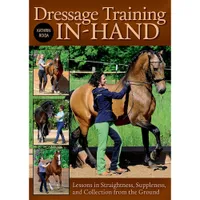
Dressage Training In-Hand | Amazon In this book, Kathrin details her methods, sharing the stories of horses of different ages, breeds, and training backgrounds, and demonstrating the steps to teaching them: shoulder-in, travers, renvers, pirouettes, half-pass, piaffe, passage, canter work, the Spanish walk, and much more.
Before you can do any meaningful in-hand work, your horse needs to trust the whip as a guiding aid – not fear it as punishment.
“From the ground, we can teach the horse that a whip resting lightly on the top line means halt,” says Charlotte. “Then, touching the girth area means go forward. Just as the calf at the girth is a ridden aid, the whip becomes a ground aid. With those two – start and stop – you have the basics.”
Why it helps: Establishing clear “start” and “stop” buttons from the ground creates a shared language. That clarity carries through every other in-hand exercise – and later, under saddle.
2. Hindquarters around shoulders
For hindquarters around the shoulders, we want the inside leg to reach in and over the outside hind.
(Image credit: Isabel Pearce)
How to do it: Stand by the horse’s shoulder, facing slightly towards the hind end. Hold the reins – or line – in your inside hand, whip in the outside hand, angled towards the hind legs. Then, ask for a step of the quarters around the front end by gently tapping the hindquarters while keeping a light feel on the reins. You want the inside leg to reach in and over the outside hind leg. Reward even one correct step.
Why it helps: Teaches the horse to bring the hindlegs under and respond to sideways aids. Begins to mobilise the hips.
3. Shoulders around hindquarters
How to do it: Position yourself just behind the horse’s head, body angled slightly towards the shoulders. Keep the neck softly flexed inwards and use the whip near the shoulder to ask the front end to step around the hindquarters. Take it one stride at a time.
Why it helps: Separates front end from hind end, develops shoulder control, and lays the foundation for shoulder-in.
4. Lateral basics
For leg yields, try it on a line you use when riding to maximise the benefits.
(Image credit: Isabel Pearce)
How to do it: Position yourself near the horse’s shoulder, holding the reins in your inside hand and whip in the outside. Next, walk purposefully but steadily with the horse on a diagonal line. Face the horse as you move, matching your steps to their rhythm.
Keep the aids clear and simple – tap lightly with the whip at the girth to ask the hindquarters to step away, while maintaining a soft inward flexion with the reins. Reward every correct crossing step, even if it’s just one or two at first.
Why it helps: “As well as activating the core, the horse is developing an understanding that will become the foundation of your ridden work, that’s why it makes sense to use the same lines as you will use when riding,” Charlotte explains.
Building it into your routine
With all of this work, it’s worth remembering that in-hand training is physically demanding, even without a rider on board. You wouldn’t thank a Pilates instructor for making you repeat the same exercise endlessly! Start with three to five correct steps and build progressively.
But whatever your horse’s age, size or breed, all can benefit from short, regular sessions. Even five to ten minutes in-hand before schooling or hacking can switch on the right muscles and improve focus.
Are you a fan of using in-hand work as part of your horse’s regular exercise routine? Let us know what benefits you’ve seen at hhletters@futurenet.com, including your name, nearest town and county, for the chance for your letter to appear in a forthcoming issue of Horse & Hound magazine. Letters may be edited for clarity and length.
Did you find this article helpful? You may also enjoy…
Oscar joined Horse & Hound in October 2023 and is the magazine’s dressage editor and sports manager, overseeing coverage of equestrian sport. After studying equine science at Myerscough College, he spent four years working for leading dressage rider Emile Faurie, competing at the 2015 National Dressage Championships and travelling with the yard to CDIs including Aachen and Saumur. He holds a master’s degree in Literature from York St John University (2021).