How your stable roof could be the ultimate water recycling tool – and be the adaptation we need to survive the water crisis
In today's changing climate, traditional water management on the yard is no longer sustainable, but harvesting rain water is something all horse owners can consider


Climate change and population growth are placing huge strain on water supplies and the Environment Agency is predicting that England will face a five billion litre a day shortfall for public water supplies by 2055.
Warmer, wetter winters and hotter, drier summers mean the water table is encountering extremes. We are unable to capture the excessive rainfall we experience in the winter due to inadequate infrastructure, droughts in the summer mean less rain, and warmer weather means more water evaporates and the soil dries out quicker.
How the water crisis will affect horse owners
As horse owners, we use more water than most. Alongside providing it to our horses for drinking, we also use it for various aspects of their care and maintenance such as washing, cleaning, soaking hay and feed, cooling horses and, if you have an arena, you will also be aware of the regular need to water it.
The water situation is serious for equestrian sport, says Ruth Dancer, director at the environmental consultancy company White Griffin.
“It’s much more than just hosepipe bans. By 2030 a significant proportion of the country will experience extreme water shortages. We have five years to put infrastructure and practices in place to be more self-sufficient.
“We’re so used to having water readily available that I really worry this is a topic that seriously flies under the radar for most of the population, and certainly equestrians.
“I think it’s incredibly important that people like myself raise the alarm,” says Ruth. “Not to panic people, but to say, ‘If we prepare now, there are things we can put in place through slow, steady investment over a few years,’ rather than a panic approach in five years’ time. For the regular horse owner, it’s about thinking, ‘How do I work with nature rather than fighting against it?’
Never miss out on the latest happenings in the equestrian world
“I think a lot of people don’t realise that water stress is going to be a massive issue in this country,” explains Ruth, who urges that we need to understand that water stress isn’t a ‘maybe’: it’s going to be a reality.
“Combatting severe water stress means limiting the times a day when you can use water, as well as the volume. This is serious for a sector like equestrian, because using water is a welfare issue, not just in terms of hydrating and cooling our horses, but watering our arena surfaces to reduce respiratory problems, too.”
Ruth adds that water will evolve as a commodity, costing more to use. “Water will likely become a lot more like electricity; most people are concerned about their electric usage because their bills are very high, and as water becomes more expensive, then attitudes towards use will shift.”
“Hotter, drier summers and warmer, wetter winters are the pattern for the UK moving forward,” she explains. “We need to learn to work with that.”

Wetter, warmer winters are going be the new normal in the UK
For Ruth, the ideal culture shift is a move towards water self-sufficiency, which means embracing rainwater harvesting. This is just one way horse owners can be more sustainable.
“This is something that’s reasonably normal for farmers. There are companies out there that supply rainwater harvesting on a very large scale for agriculture and business,” adds Ruth, but she explains there are examples of smaller-scale harvesting on livery yards of all sizes, and even on private yards.
“We’ve got these lovely stable roofs perfect for collecting rainwater. Even if you’ve only got one or two stable roofs and one smallish container, it’s free water. And, there’s technology and maintenance you can invest in to make sure you can store it and it’s clean.”
What is rainwater harvesting?
Rainwater harvesting is the process of collecting and storing rainwater from gutters and downpipes that would otherwise flow into the drain.
Methods can be as simple as placing a bucket or container under the drip line of a roof or a downpipe, or more complex like installing an underwater pumped system.
Harvested rainwater can be used for:
- washing horses
- drinking
- soaking hay
- cleaning tack or equipment
- watering arenas

Can horses drink harvested rainwater?
Harvested rainwater is not ‘potable’, or fit for human consumption, unless appropriately treated and filtered.
Horses can drink harvested rainwater, however, but care needs to be taken to ensure it is free from contaminants and the system is maintained regularly.
The UKRWA (UK Rainwater Management Association) recommends multi-stage filtration and UV treatment is considered at yards where harvesting rainwater for equine consumption and soaking hay.

You don‘t need to invest in a large setup to start making a difference
Benefits of rainwater harvesting
- Reduces water waste
- Potential to save a lot of money
- Reduces rainwater runoff, which helps protect grazing during wetter winters, and flooding
- Supports biodiversity net gain and water neutrality goals, which may assist with rural grants or planning approval
- Secures a water supply in times of drought and making yards more resilient to climate change
Other ways horse owners can save water
Other measures include:
- turning taps off
- fixing leaks
- using mechanisms such as SealStop to prevent buckets and troughs overflowing
- letting your horse’s drink their trough down before emptying it to clean
- reusing water from troughs to water plants, or from water buckets to add to feeds or clean feed bowls
- installing automatic drinkers
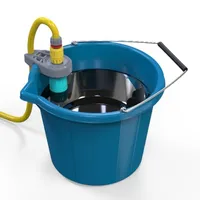
Connects easily to any standard ½-inch UK hosepipe using a quick-connect fitting, no tools or setup required. Just attach, fill and walk away while SealStop stops the flow when your container is full.
Rainwater harvesting systems in practice
In simple terms, rainwater harvesting gives property owners access to supplementary water alongside – and, crucially, separate from – their mains water supply.
“This water does not meet regulatory standards for mains water, nor is it ‘potable’, or safe for human consumption,” explains a spokesman from the UKWRA, a trade organisation championing water reuse as a defence against future flood and water shortage risks. “This is why it must be stored separately from mains water to avoid cross-contamination.”
Using drainage pipework, rainwater is collected from sloping roofs of any kind, including barns and stables.
Rainwater is fed through a filter and into an above-ground or underground storage tank. Individual harvesting systems have bespoke filtration and pumping systems, from domestic use of toilet flushing to outside use only for watering plants and washing cars.
According to UKWRA, a basic setup for stable yard cleaning, horse wash-down bays and rinsing tack and equipment could include:
- a guttering system on stable roofs
- leaf guards and first-flush diverters to improve water quality
- a small above-ground tank up to 5,000 litres, suitable for capturing run-off
- a basic filter, possibly a low-pressure pump or gravity-fed hose
Costs
You could spend anything from £2,000 to in excess of £30,000 to install a rainwater harvesting system, but Ruth adds that, for the average horse owner, you can be as sophisticated as your budget allows and you don’t have to spend thousands.
“If you’re canny and have a few bits of drainpipe and a water butt, you can rig up your own small-scale rainwater collecting system,” she says. “It’s perfect for watering plants, rinsing equipment and washing horses down.”
If you owner a large or commercial yard and want to educe the reliance on mains or borehole water, you could install a system that could deliver water for arena irrigation, toilet flushing, laundry facilities and even animal consumption, subject to appropriate filtration and treatment, but this, of course, will require an investment.
For more information and advice on rainwater harvesting, visit the UKWRA’s website.
Maintainance
DIY maintenance is possible for smaller systems, but the UKWRA recommends a service contract or annual check by a qualified technician, especially for larger or more complex systems.
While there is no mandatory inspection regime for rainwater harvesting systems, UKRWA recommends that all commercial users adhere to the BS EN 16941-1:2024 standard, which is a rainwater harvesting code of practice. Additionally, they advise planned routine maintenance and checks, especially where systems supply water to humans or animals.
Above-ground tanks might be more convenient for cleaning and inspection, but they are prone to algae growth and require protection from UV exposure, such as opaque tanks and protective covers to reduce this.
Other precautions include visual inspections every few months for algae, sediment and structural integrity. Annual cleans, or cleans as necessary, are essential.
Below-ground tanks are less exposed to light and temperature changes, so there is lower biological activity. You need to arrange for annual inspections to check for silt build-up or debris.
Ruth is a chartered environmentalist and has an MA from Cambridge University. She specialises in sustainability projects in the sporting sector and her company supports the sport and culture industries with transitioning their operations to a sustainable future.
- For unlimited access to expert advice about how best to look after your horse, subscribe to the Horse & Hound website

A horse owner and rider with more than 20 years experience, Bethany has been writing for equestrian publications since 2017. Over the course of her career, she has reported from major British Riding Clubs and British Dressage championships, covered Badminton Horse Trials and interviewed equestrian sport’s best athletes. Her work can also be found in Country Life, The Field and Breathe magazine.
- Emily Bevan Freelance writer