There is real doubt about how safe “safety stirrups” are – but manufacturers have been urged to help work towards a safety standard.
British Equestrian Trade Association (BETA) executive director Claire Williams gave an overview of the situation, at the BETA safety conference on 21 April.
“Please, whenever I say ‘safety stirrups’, think about inverted commas, because the one thing that’s come out of work we’ve most recently done is that there’s real doubt about how safe so-called safety stirrups are,” she said.
Ms Williams said BETA first looked into perception and use of safety stirrups in 2021, as there had been “huge growth in the use of safety to market products, but often no indication of whether the product reduced risk of accidents or injury, or whether there were any aspects whatsoever of safety around the product”.
“It’s a constant source of surprise, to people within the equestrian world and without, that so many products we use have no standards associated with them,” she said “I also find it slightly ironic that while we have standards for everything that goes on us, there’s virtually no safety standards for anything that goes on the horse.
“I thought we were nearing the start of the development of a European standard. I felt it was time, five years later, to check where we were at.”
The most recent study considered riders’ views of safety stirrups and the need for a standard, and compared them to the 2021 results.
She said BETA riders see safety stirrups as those that prevent a foot getting stuck in them, so the foot will be released “in all circumstances”, which is an issue.
Safety stirrups: absence of risk?
“To many riders, it’s a total absence of risk,” she said. “Use has escalated dramatically, covering occasional and constant use. So while adoption has increased, sadly confidence has not. They’re buying them despite having uncertainty, not because that uncertainty has been resolved.
“Riders are now calling into question the use of the word ‘safety’ in association with stirrups, and there is still confusion around what’s safe and which mechanism is best.”
Ms Williams said the survey found more demand for evidence and testing of safety stirrups, the use of which has almost doubled since 2021. Many riders expressed concern about failures of stirrups, or the use of the word “safety” for marketing rather than as a measure of performance.
“When we look at why riders aren’t using them, that tone is changing,” she said. “In 2021 they were uncertain about what was being offered. This year, we saw a real shift to riders questioning the claims of safety and the lack of evidence to justify that term.
“Now it’s more about risk resistance than price resistance; riders expressing concerns about false safety, inconsistent performance and mechanisms that might fail. We repeatedly saw a real gap in trust.
“There’s an issue of a credibility vacuum and riders making their own risk assessments because there’s no recognised standard. Brand claims are often conflicting and there are anecdotal failure stories, which tends to carry more weight than marketing.”
Attempts to establish a standard
Ms Williams said the range of products offered led to the attempts to create a safety standard, which “is going to be incredibly challenging”.
“Even among sceptics, the demand for a standard is strong,” she said. “We asked, ‘Would you be more likely to use a safety stirrup if there was a standard?’ And around 55% in 2021 said yes, this time it was 60%. So for better or for worse, there is real belief a standard will raise the bar in terms of safety.”
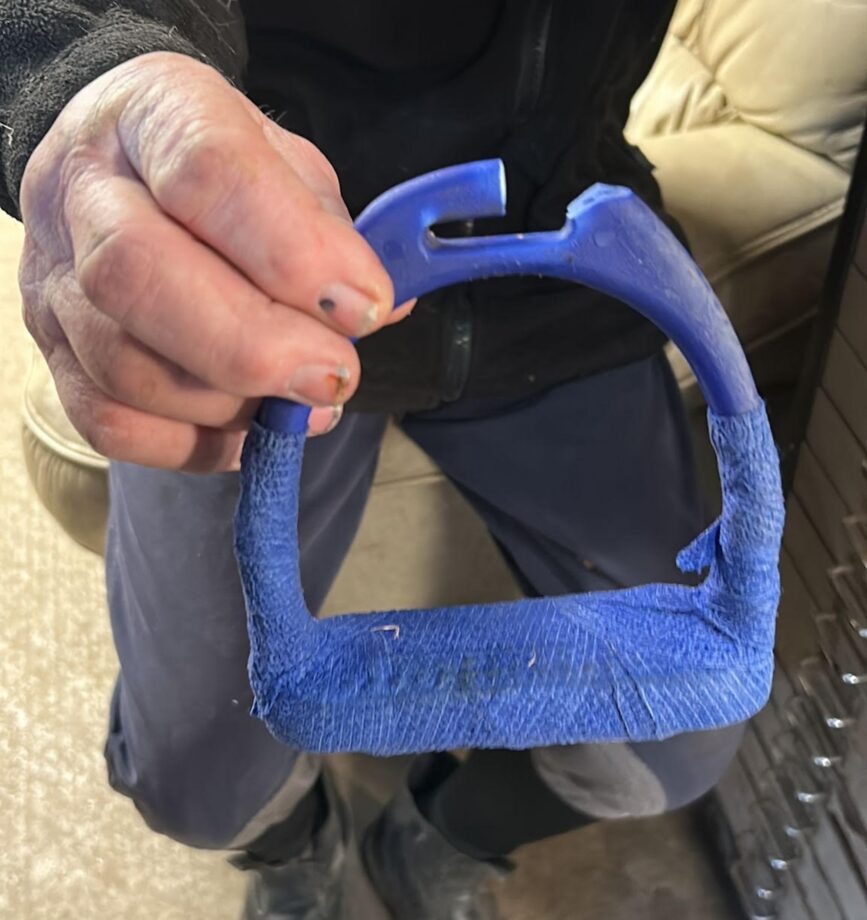
Ms Williams said minimum criteria for a safety standard would include reliability, independent testing and the fact the safety function should not alter the stirrup’s performance. She cited the recent case of Mark Smith, a 75-year-old rider whose unbranded stirrup broke while he was riding in a point-to-point, as reported by H&H.
“The fact a stirrup like this can be put on the market, and put riders at risk, it really does question whether we need a standard for all stirrups, never mind safety ones,” she said. “That’s what we’ve been working towards. It is a challenge.”
BETA asked manufacturers to come forward to contribute to a standard working group, four years ago, but only one came forward. The European technical committee responsible for standardising sports equipment agreed to set up a working group to start developing a standard but not enough of the countries nominated to take part put forward enough experts for it to go ahead, so the group no longer exists.
“We’re not giving up”
“We’re not going to give up as having a European standard is really important,” she said.
“I would like to, once again, extend an invitation to companies involved in the stirrup manufacturing world to come forward and start that work, to put together the key criteria that would need to go into, frankly, a stirrup standard with the element of safety included. We need to start work now. We can’t delay any longer, because it really is key for safety.”
Mark Smith, who fell when his plastic stirrup broke at the Old Berks Hunt meeting on 6 April, told H&H he wants such items banned unless manufacturers can prove they are safe, and thinks there should be a safety standard.
“The authorities make such a fuss about standards for hats or body protectors; I can’t believe there isn’t one for stirrups,” he said. “I can’t let this lie as if it happened to anyone else, I’d never forgive myself.”
- To stay up to date with all the breaking news from major shows throughout 2026, subscribe to the Horse & Hound website
You may also be interested in:

‘You couldn’t make it up!’ 75-year-old rider denied charity win owing to broken stirrup raises serious safety concerns

‘You only get one life and one head’: Olympic medallist speaks up on rider protection
‘When whips are fashion accessories, what message does that send?’ asks equine welfare expert

Subscribe to Horse & Hound magazine today – and enjoy unlimited website access all year round