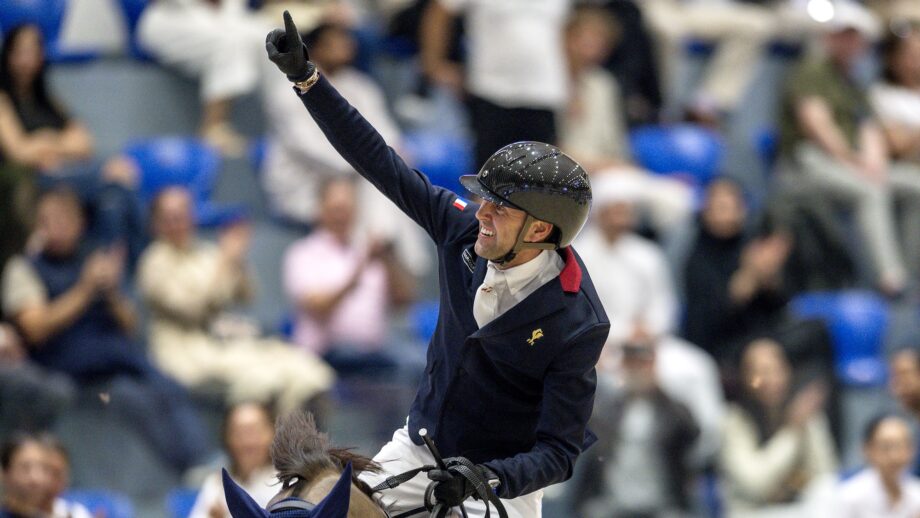
A top rider who was retroactively eliminated from a major class as his hat came undone during his round has had his appeal quashed by the FEI Tribunal.
French Olympic and world team medal-winning showjumper Simon Delestre jumped clear in the GCL (Global Champions League) Super Cup quarter final at the Global Champions Playoffs in Prague last November. But after the class finished, officials told him he had been eliminated because his helmet’s harness had come unfastened at some point during his round. Under FEI rules, riders’ hats must be fully fastened.
This meant the team Simon was competing for, the Istanbul Warriors, were knocked out of the rest of the competition.
He appealed the decision with the ground jury at the show, who dismissed it.
“To date, I am one of the few riders to have experienced such a firm and definitive interpretation of this FEI rule,” said Simon at the time. “I find this decision unfair and inappropriate. Why do other riders, in the same circumstances as me, have their scores upheld, while I am disqualified?”
The GCL and Prague Playoffs Organisation said at the time it believed it “should not influence the rider’s result or carry any implication to the team results”. A spokesperson added: “While we respect that we are not the FEI or the official judges who are responsible for rule enforcement, we must express our disappointment with the decisions which also have a significant impact on the wider event.”
Simon took the matter to FEI Tribunal.
He argued that the decision “violates the FEI’s own regulatory framework and fundamental principles of fair play” and is also “grossly disproportionate in light of an unintentional equipment failure that was neither observed nor sanctioned in the field of play”.
Simon also argued that it was not a real-time sporting judgement made on the field of play, but rather he was eliminated after the competition “had fully concluded, after the official results had been published” and following a video seen after the class.
He argued that it was not a “decision arising from the field of play”, but the FEI countered this with a statement that “the ‘field of play’ definition concerns the nature of the decision, and not the timing”.
The point about whether something is a field of play decision or not is critical, as the FEI Tribunal views such decisions as binding and non-appealable.
“The fact the elimination was retroactive does not strip it of its ‘field of play’ status,” stated the FEI’s submission.
“Many FEI officials’ decisions pertaining to matters occurring in the field of play are actually taken after the athlete’s round. For example, blood on a horse is assessed at the boot and bandage control that can take place both pre- and post-competition.”
The FEI Tribunal ruled that determining whether the rider’s helmet was unfastened at some point during the class “is unequivocally a ‘field of play’ decision” and that the appeal is “non admissible”.
“The fact that the GJ [ground jury] decided on the matter after the class, and after the results were published, does not render it an outside the field of play decision,” it added. “Quite to the contrary [the rules] specifically allow for the use of video to assist the FEI officials in carrying out their responsibilities, which is to be understood, in the present matter, as taking decisions related to the field of play.”
H&H has contacted Simon for comment and to ask if he plans to appeal to the Court of Arbitration for Sport.
- To stay up to date with all the breaking news from major shows throughout the year, subscribe to the Horse & Hound website
You may also be interested in:

‘We’re delighted to bring loyal readers this benefit’: H&H magazine subscribers get free website access
The race to be leading rider ends in a three-way tie: three titles each at the Winter Dressage Championships

‘He’s phenomenal’: watch as horse and rider jump classic Range Rover with ease
Top judge with extensive CV reveals what she’s looking for – and hoping not to see – in the ring