The creator of a new framework to be used to train horses hopes to challenge traditional thinking, calling for riders to “stop blaming the horse”.
Marcel Olivé, whose aim is to combine natural horsemanship with the latest behavioural science to improve equine welfare, has published the “Horse hierarchy of needs” as a free resource. The premise is that without fulfilling horses’ needs from the bottom up, they cannot achieve their full potential, whether this is in performance or just a harmonious relationship with the rider.
“For generations, the equestrian world has operated on a simple premise: when a horse misbehaves, the rider must correct the behaviour by increasing pressure or changing the training tool,” Marcel said. “Today, I am challenging that deeply ingrained narrative.”
Marcel used behavioural science and other research for his book, The Truth About Your Horse, to create the framework, which is visually represented as a pyramid.
The base of the triangle is the horse’s physiological needs, the “non-negotiable”, fundamental elements needed for survival, including food and water, and freedom from pain. The next step is safety, followed by socialisation and confidence and the peak: fulfilment.
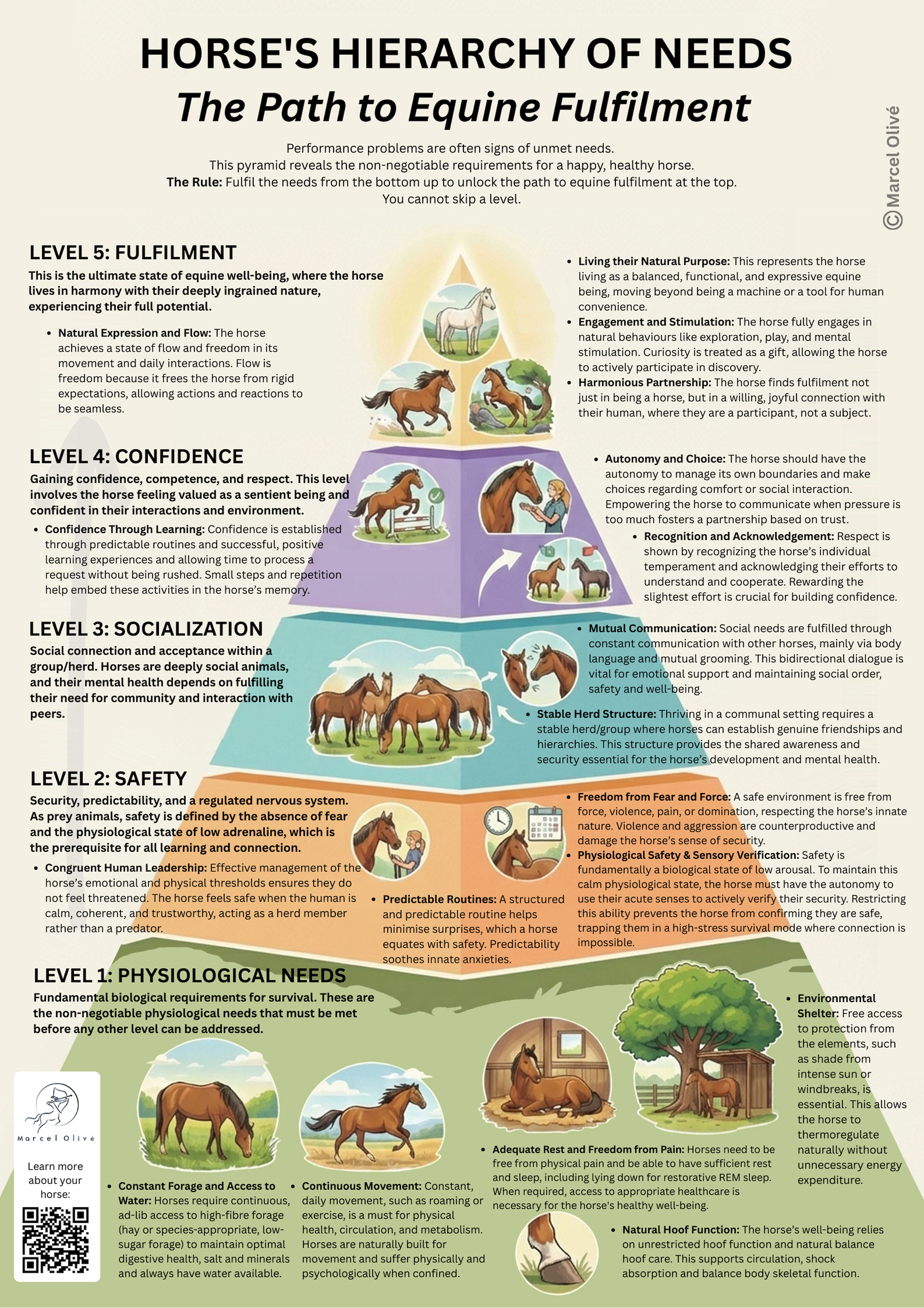
“You cannot skip a level,” Marcel told H&H.
“Level one is the physiological needs, that keep the horse alive. But then, the horse needs to feel safe; if the horse doesn’t feel safe, you can train anything you want and won’t get the performance. If the horse is safe but can’t socialise, so the mental health isn’t there, if you can’t solve that, you can’t go higher up.
“If you have all that and the horse isn’t confident, you still won’t get the performance you want as the horse will have it doubts. If you master all the levels, the horse will be fulfilled, and in performance you can get 100% from the horse and the relationship. If you don’t want to compete, but it’s about your enjoyment of and relationship with the horse, but it’s the same.
“In training, many people if they fail at something, they keep pushing, when you should take a step back, then try again, step by step.”
Marcel said he believes many riders are treating symptoms, such as unwanted behaviour, without tackling the cause.
“You can’t build the roof of high-level performance if the foundation of physiological comfort and safety is cracking,” he said. “If a horse is struggling to focus, we have to stop looking at the bit in their mouth and start looking at their lifestyle.”
Marcel said if a performance issue crops up, the aim should be to investigate from the bottom of the pyramid; is the horse in pain or discomfort and if not, does he feel unsafe, or perhaps he is not confident; once this is remedied, progress can be made.
Using the horse hierarchy of needs
“You always see this blaming of the horse,” he said. “And the way we speak: ‘My horse is naughty’. Labelling horses is usually because we don’t understand them at that point.
“We need to listen; horses will do everything for you but they need to understand what we’re saying to them. The horse is doing something because it doesn’t understand you, or it’s telling you: ‘No’; people say the horse is being naughty but it’s just trying to tell you things; if they misbehave, it’s maybe because they’ve told you 10 times already and you’re not listening, so it’s their only way to tell you.”
Marcel said he hopes the framework, which can be downloaded in poster form, will help change attitudes. He added that it was created thinking not only about horses in human care but those in a natural environment as all the same factors are important.
“We can’t keep a horse 100% of the time in a ‘natural’ environment but we should understand that they need, for example, to socialise with other horses,” he said. “Sometime horses are tortured, with good intentions. I hope at least to create awareness.”
> Do you think attitudes to training horses are changing for the better? Write to us at hhletters@futurenet.com, including your name, nearest town and county, for the chance for your letter to appear in a forthcoming issue of the magazine. Letters may be edited for clarity and length.
- To stay up to date with all the breaking news from major shows throughout 2026, subscribe to the Horse & Hound website
You may also be interested in:

‘I’m glad I listened to him’: horse who ‘exploded’ when ridden found to have wire embedded in his forehead

‘Never blame a horse for poor behaviour’: the five facts your horse would like you to know
‘We’ve got to be better at listening to horses – their behaviour is their conversations with us,’ says equine welfare expert

Being a pain, or in pain? We need to listen to our horses
Subscribe to Horse & Hound magazine today – and enjoy unlimited website access all year round