Horses who get their beauty sleep learn better than their sleep-deprived counterparts, a new study has found.
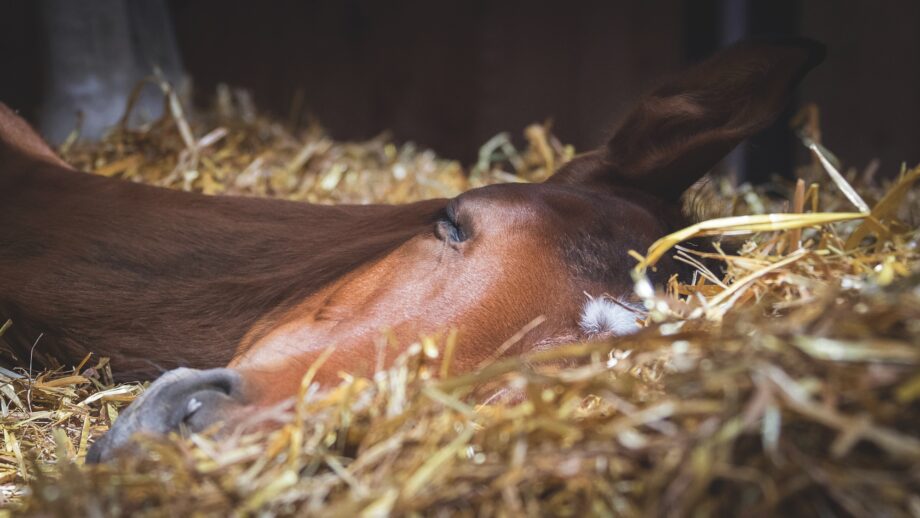
Researchers at the University of Helsinki discovered that horses who had more than 30 minutes of REM (rapid eye-movement) sleep at night performed better in a new learning test than those who did not. REM sleep can only be achieved when a horse is lying down.
The study did not involve keeping horses awake and no external signs of sleep disturbances were seen during the study. Rather, it monitored REM sleep in a group of 16 riding school horses in their normal environment over the period of six weeks. In this time, researchers conducted five sets of behavioural measurements, each lasting 48 hours.
During the day, the horses took part in a learning test, in which their perseverance and performance were monitored. As a starting point, the horses were taught to touch an upturned bucket for a treat. Once the horse learnt that, the test became more complex – another upturned bucket was put in his field, but only one would result in a treat if he touched it.
After seven correct touches, the rules changed and he needed to touch the other for his reward of a piece of carrot. All bar one of the horses picked up what to do, but those with less REM sleep gave up more easily.
“Shorter REM sleep did not increase the number of mistakes, but had a particular effect on how long the horses worked on the task,” said study author and vet Mira Hämäläinen. “This suggests that REM sleep in horses is associated with motivation and perseverance.”
She added: “While the horses were quick to learn simple tasks, the effects of short REM sleep periods started to show in longer and more demanding tasks.”
Doctoral researcher Iina Brotherus, who studies equine sleep and co-authored the study, said the findings offer a new tool for assessing the learning capacity and welfare of horses.
“They also emphasise the importance of sleep as part of their overall wellbeing,” she said.
Co-author Laura Hänninen told H&H the study started through Ms Hämäläinen’s work to develop a learning test and research into bedding conditions, but during the monitoring of the horses, they found these “fascinating results”.
“We noticed these normal-looking, healthy riding school horses – none of whom had any sleeping problems that we could see from the videos – were resting in different amounts and behaving differently in the test,” she said.
“Horses have this unique evolutionary adaptation skill where they can postpone their REM sleep for weeks, in some cases in months, but that comes at a cost. But even this slightly reduced amount of REM sleep came with the cost that they didn’t function in the test as well as their friends who were sleeping better. That was a surprise.”
She said this link is something that has been seen in other species, including humans.
Adjunct Professor Hänninen added that the findings raise “many questions to be studied”. For example, looking into other types of horses, such as those with known clinical sleep problems.
She also raised the point that the horses in this study were riding school horses, adding: “We don’t know if professional horses have maybe quite different cognitive skills – they have to adapt to being in a vehicle, different stables, at competitions. It would be quite interesting to see how they would function in the test.”
The study was conducted in collaboration with the Finnish Equine Information Centre, Tuire Kaimio and Henna-Kaisa Wigren, a researcher from the SleepWell group active in Meilahti.
H&H vet Karen Coumbe said: “This is interesting, not least as well as the most obvious point that it is in line with the findings from various other species showing that reduced REM sleep is associated with suboptimal mood, performance deficits and impaired learning. It is also relevant that the horses pick up on the cues from their handlers – visual and otherwise, which I sometimes think is easy to forget.
“We should be so aware of how horses need their sleep – same as us.”
- To stay up to date with all the breaking news from major shows throughout the year, subscribe to the Horse & Hound website
You may also be interested in:

‘We’re delighted to bring loyal readers this benefit’: H&H magazine subscribers get free website access

Do horses sleep standing up? H&H explains all…
Is your horse getting enough sleep?
Lack of shuteye could make a big difference to his mood, health and performance, says Kieran O’Brien MRCVS