The FEI will go ahead with changes to the so-called blood rules in showjumping that have divided opinion – but Britain will not follow suit at national level.
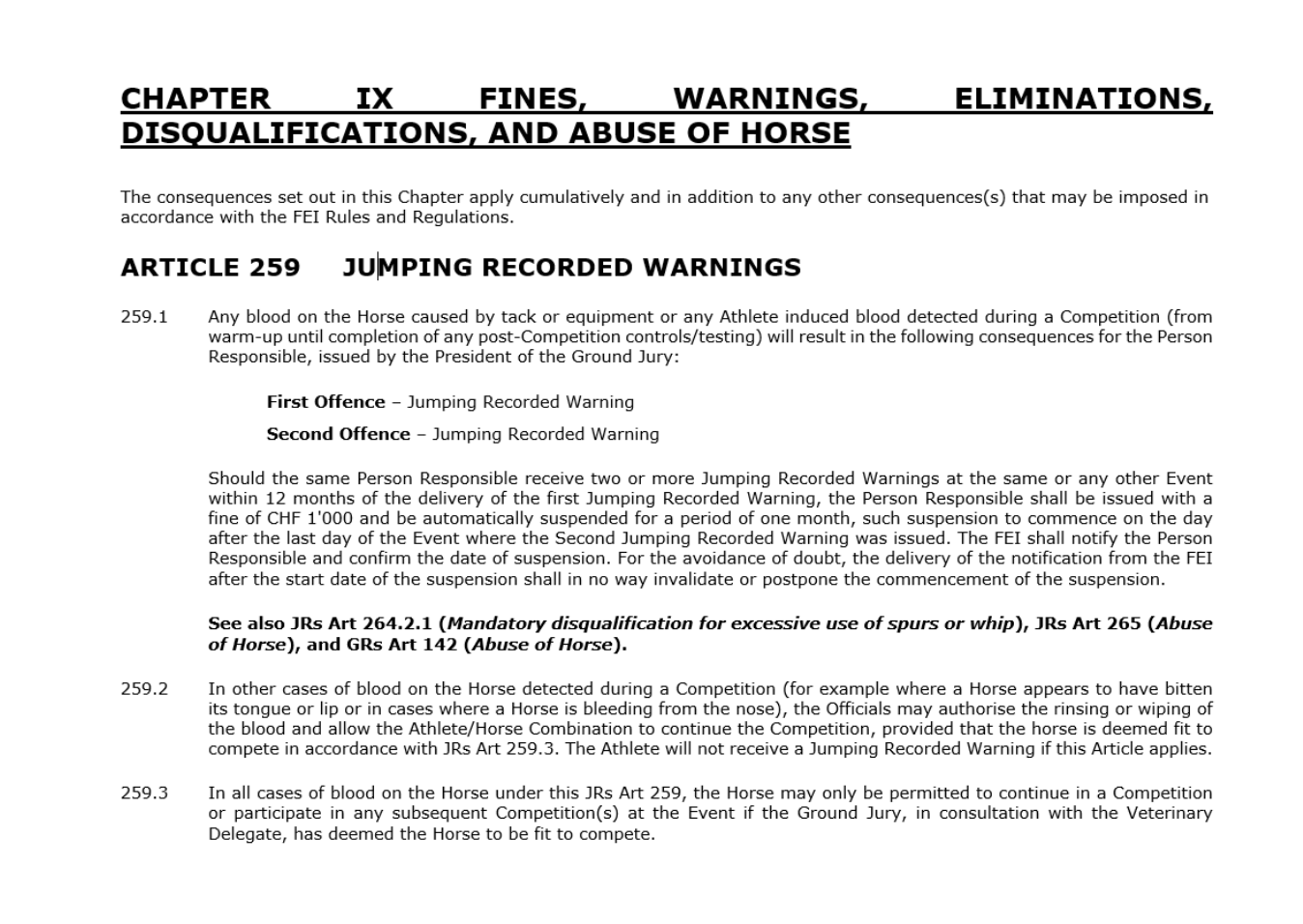
The new rule, which will come into effect on 1 January, states that rider-induced blood on the horse will no longer lead to automatic elimination. Instead, a system of jumping recorded warnings will be introduced.
The first two violations of the rule will result in recorded warnings; two or more recorded warnings within 12 months will mean a fine of CHF 1,000 (£945.45) and a one-month suspension.
In cases of blood where a horse appears to have bitten its tongue or lip, or is bleeding from the nose, the blood may be wiped and the combination can continue, “provided that the horse is deemed fit to compete”. No warning will apply in these cases.
In all cases of blood under this rule, the horse may only be permitted to continue in a competition or participate in any subsequent competitions at the event if the ground jury, in consultation with the vet delegate, has deemed the horse fit to compete.
Automatic elimination for marks that indicate excessive use of spurs remains in place.
Rule changes are voted on by national federations at the FEI’s General Assembly each year. In certain cases, separate votes for individual rules can be requested, which was the case here.
Britain was among the national federations that opposed the change – and British Showjumping (BS) will not be changing its national rules.
A joint statement from British Equestrian (BEF) and BS today (7 November) said that “despite efforts from our delegation and other leading national federations to halt the proposal, the rule was passed by 56 votes to 20, with two abstentions”.
BEF chief executive Jim Eyre said: “We support the FEI’s commitment to equine welfare, but based on the evidence and expert opinion, we could not support this rule. The vote was far from unanimous, and we welcome the FEI’s pledge to ongoing review and dialogue.
“If horses are to have a future in sport, we must demonstrate unwavering respect for their welfare. That means clear, ethical rules that put the horse first. We remain committed to working with the FEI and fellow federations to ensure fairness, clarity, and the highest standards of care in equestrian sport.”
British Showjumping chief executive Iain Graham added: “As leaders in equestrian sport, our duty is clear: protect our athletes, human and equine, and put horse welfare at the heart of every decision.
“While we recognise the riders’ concerns and welcome elements like enhanced veterinary checks and tougher penalties for repeat offences, removing automatic elimination for visible blood is a step backwards. It risks eroding public trust and undermines the very progress these changes aim to achieve.
“We’re also disappointed that the FEI chose not to advance the use of padded batons over traditional whips in international jumping – a missed opportunity for meaningful reform.
“British Showjumping will not be changing our national rules in response. We remain committed to evidence-based decisions and stand firmly behind the British Equestrian Charter for the Horse, built on empathy, care, respect, consideration, ethics and learning.”
What did the FEI say?
In a statement this morning, the FEI described the rule (article 259 in its 2026 showjumping rules) as “a meaningful advancement, enhancing horse welfare through added measures and safeguards”.
The FEI noted the new mandatory fitness to compete checks in all cases of blood, and said the rules are clearer for FEI officials – nodding to removing the “minor” distinction and ensuring greater consistency and objectivity.
It also highlighted increased transparency and accountability for athletes, as all jumping recorded warnings are published by the FEI, and national federations are automatically notified.
The FEI pointed out that rules that remain unchanged are: mandatory disqualification for excessive use of spurs, abuse of horse provisions and the possibility of opening separate disciplinary proceedings to impose additional sanctions.
“We fully acknowledge and thank the national federations for the constructive discussions throughout the week, which clearly reflected a shared commitment to finding solutions,” said FEI secretary general Sabrina Ibáñez.
“Despite differing opinions, we were able to gain a clearer understanding of each other’s positions and were also able to clarify several misunderstandings and misconceptions.
“We acknowledge that the approval was not unanimous and have taken note of the request from several national federations for a more harmonised approach to the topic across disciplines and we are committed to looking into this.”
Ms Ibáñez added: “We will take a structured, evidence‑based approach grounded in thorough consultation and driven by data.
“Our ongoing projects at the FEI will play a key role in supporting accurate data recording, and we will continue to advance safety and welfare through evidence‑based measures that are both rigorous and robust to further demonstrate our unwavering support to horse welfare.
“We acknowledge that a number of national federations voted against the proposal. While their reasons may vary, we take this outcome seriously and are committed to examining it carefully to better understand the concerns and address them as we move forward.”
Ahead of the vote, FEI president Ingmar De Vos thanked the jumping department and others for their discussions and said the cross-references to other rules “make it clearer that this is a good rule and much better than the existing rule”.
“I would like, again, to thank you for the very constructive debate. But discussions and decisions regarding such sensitive topics need to be scientifically based, not based on emotions and certainly not based upon panic,” he said.
“We should be careful that we are not going to discuss these topics every year, again and again, because it does only one thing: it gives ammunition to activists and to our so-called critical friends to bring our sport and our athletes into discredit. We should not do that again and again. I know we are together in one thing: we all want to have the best for the horse. We all want to do what is necessary to preserve horse welfare, and we are doing that.”
He added: “You have requested a separate vote on that [article 259], and that’s fine. The governance of our organisation allows you to ask for that, but be careful what you want to send as a message by doing it.
“We, as an FEI, we are not going to explain to the rest of the world why you vote against them, because for us, it’s a no-brainer that this rule needs to be approved, because it’s better for our horses, it’s better for our athletes, it’s better for our sport.
“I think we must have a bit more confidence in the expertise of the people who have been working on this, and we should not have any doubts about the good intentions the athletes had, because this rule was proposed by the athletes.
“The athletes came to us to ask to change it, further to what happened in Paris, and we listened to them. Let’s not forget that the athletes are at the centre of our sport, nobody else. So we listen to them and we help them to accommodate them. And I think that we need to respect the people who have been working really hard on this to make this rule better.
“Yes, we need to communicate better. But we also need to be strong together to do what is right for our sport, for our horses and for our athletes.”
Where did this come from?
Debate over the so-called blood rule is not new and H&H has been reporting on discussions surrounding it for years.
In July, the FEI released its first draft of proposed rule changes. These included a call from the International Jumping Riders Club (IJRC) for proportionality around sanctions for micro cases of blood, particularly when riders are eliminated at championships – as was the case with Brazilian rider Pedro Veniss in Paris.
A revised version of this was then included in the final draft of the FEI rules for 2026, which were shared this autumn.
Responding to concerns about the proposals, IJRC director Eleonora Ottaviani told H&H the club puts “horse welfare and health above everything”.
She said the IJRC worked with the FEI on a proposal that is “even stronger than the previous rule” owing to the introduction of a possible fine and suspension – and highlighted that the horse abuse provisions remain unchanged.
What else has happened?
H&H reported last week on a petition started by German equestrian journalist Claudia Sanders calling for “this proposed relaxation to be stopped”, which has now been signed by more than 66,000 people.
“I did not expect the FEI to so completely disregard the needs of the horses,” said Ms Sanders.
“I am deeply disappointed. This decision sends a devastating message: blood is no longer a warning sign, but merely a bureaucratic detail. We cannot and will not accept this – we will not give up the fight to protect the horses. We owe it to them.”
What is the exact wording of the new rule?
This is the exact wording from the FEI rules:
- To stay up to date with all the breaking news from major shows throughout 2025, subscribe to the Horse & Hound website
You may also be interested in:

‘We’re delighted to bring loyal readers this benefit’: H&H magazine subscribers get free website access
Thousands sign petition against plan to ‘weaken’ blood rules in horse sport

Are the blood rules in FEI horse sport working – and how can we move forward?
New rule for tack- or rider-induced blood proposed in showjumping