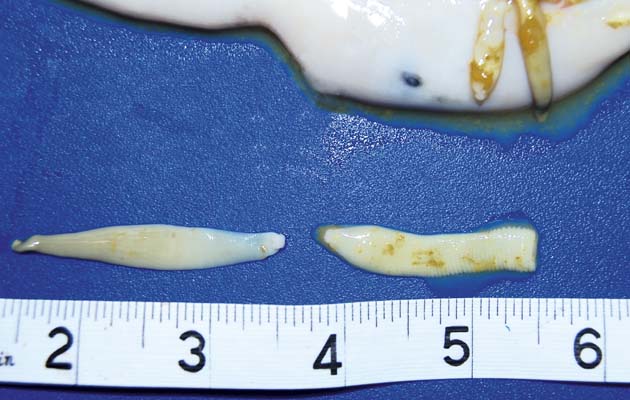
While horses can have large tapeworm burdens and appear healthy on the outside, the worms can cause problems so testing horses for tapeworm and treating them where necessary is good horse husbandry.
Unlike other worms in the horse, tapeworms develop inside an intermediate host — the microscopic forage mite. Horses become infected when they eat hay or grass containing mites, which are themselves infected with tapeworm larvae. These then develop into adult tapeworms inside the horse’s intestines.
Testing for tapeworms in horses
Testing for tapeworms cannot be done through the standard faecal worm egg count (FWEC). Either a blood test or the relevatively new saliva test can be used to identify whether your horse has a tapeworm burden in its gut.
A blood sample can be taken by your vet to test for infection, a method known as the ELISA or tapeworm antibody test. A horse with a high level of tapeworm infection will produce a large number of antibodies, which can be detected in the blood.
The test indicates a broad level of intensity, rather than tapeworm numbers. The amount of antibodies will indicate whether the burden is low, medium or high.
While the blood test is useful for assessing whether your horse has been infected with tapeworms in the past, it is not a reliable indicator of response to treatment. This is because it takes around four to five months for the antibody levels to return to normal after the worms have been killed. Therefore the test only needs to be carried out once a year.
The saliva test — EquiSal Tapeworm — has been developed by scientists at Austin Davis Biologics at the company’s laboratory in Northamptonshire. A horse’s saliva is taken by its owner using a specially developed swab, and then sent off to the laboratory for analysis.
Horses with evidence of a high tapeworm burden are likely to be susceptible to infection with tapeworms in the future. They should be treated a second time that year, before being retested 12 months later.
Treating a horse for tapeworm
There are two different approaches to tackling tapeworm. Treatment can be targeted, following a blood or saliva test, or administered within an annual worming programme.
Targeted treatment can reduce the likelihood of worms becoming resistant to treatment and identifies horses at risk of high levels of worm infection.
Using this method, horses are tested for tapeworms once a year. Those with a high burden are treated after the test and then again six months later. The test is then repeated the following year to find out how successful treatment has been.
New horses on the yard should have a tapeworm test and a FWEC, or be treated for both tapeworms and roundworms, before they are turned out with others.
In some yards, targeted worming may not be suitable nor practical. In these instances, it is best to treat for tapeworms every six months.
Tapeworm infection is not strongly linked to seasonality, so the time of year that treatment takes place is not particularly important. As risk is higher after prolonged periods of grazing, however, it seems wise to treat at the end of a summer out at grass.
It is important to be aware that not all wormers kill tapeworms. These particular parasites can be treated with one of two drugs — praziquantel and pyrantel. The latter must be used at a double dose.
Fortunately, both drugs are very effective and cause death and detachment of the tapeworms from the gut wall within 24-48hr following treatment. They are available as single products or in combination with other drugs that target different types of worms.
Parasite populations on the pasture can be reduced by regular removal of droppings, resting grazing and rotating sheep and cattle on to horse fields.
To conclude then, careful pasture management combined with correct testing and treatment will ensure that tapeworm infection is controlled.