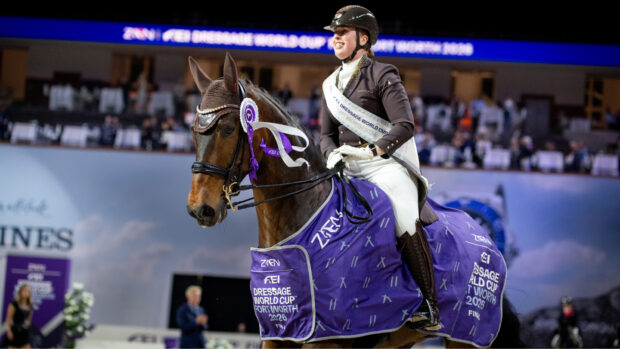
On the latest episode of The Horse & Hound Podcast, World Cup winner Becky Moody lifts the lid on what it really takes to fly a horse across the Atlantic – from crates and zip lifts to a sleepless night tracking the flight to Texas.
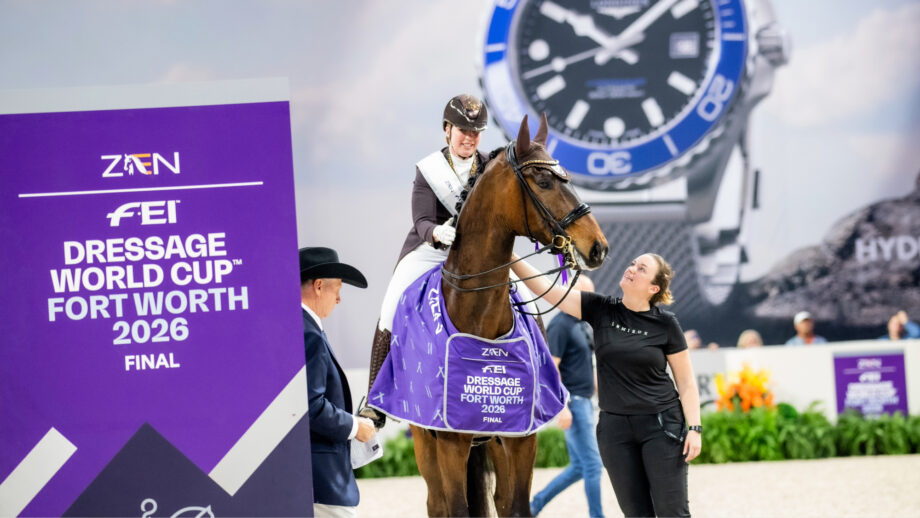
Becky’s World Cup win on Jagerbomb was one of the standout British performances of the season so far. But as she explains, getting Jagerbomb to the venue in Fort Worth, Texas, was an enormous undertaking in itself – and one she had never attempted before.
“It’s a really big deal to put your horse on a plane and fly it all the way over there,” Becky says. She admits she “ummed and ahhed” over whether to commit at all, weighing the cost and the stress against the experience. But with the Los Angeles Olympics on the horizon in 2028, she ultimately decided it was worth doing.
“I’ve never flown a horse before. He’s never flown before,” she says. “At least I know that he has now flown, and he flew really well. He coped with that side of it brilliantly.”
How does flying a horse abroad actually work?
The journey began with Becky’s long-time groom, Kim Masson, driving Jagerbomb in their 4.5t lorry to Dover for an overnight stop, before a transporter took them on to Liège in Belgium, where most equestrian flights depart Europe – and where the European contingent of World Cup-bound horses were travelling from.
The shipping agent Peden Bloodstock organised the flight itself, quizzing the team in advance on Jagerbomb’s size and how he likes to travel.
“Knowing that Bomb is so big, we made sure he had plenty of room in his crate – extra length compared to some, and plenty of width,” Becky says.
The crates, she adds, are effectively like trailers, taking one, two or three horses apiece: “It’s your first, business, economy kind of thing.” Jagerbomb shared his with just one other horse, and “loaded like a pro”.
Loading and unloading were the most stressful parts, with the horses lifted onto the aircraft using zip lifts. Watching from home as the videos came in from Kim, Becky says she was “biting my nails away”.
“I know showjumpers who are flying their horses all the time, and it’s just normal,” she adds. “But when you haven’t done it before, it’s this enormously big deal.”
She spent much of that first night tracking the flight: “I spent most of the night on Flightradar, just watching Bomb and Kim’s plane as it went all the way up to Greenland and back down again. I didn’t sleep a huge amount!”
At the other end, Dallas Fort Worth International Airport hadn’t received flying horses in some time, so the incoming flight had to bring the zip lift they used to load the horses with them on the aeroplane to unload.
From there it was a 40-minute drive in “huge, super-cool American trucks” to the venue, where – crucially – Jagerbomb could complete his 48 hours of quarantine on-site, with Kim still able to muck out, feed and hand-walk him.
Kim, who had never flown with horses either, made such an impression that she was asked to take charge of the dressage horses on the journey home.
To hear more from Becky on the World Cup win, the spectacle of Fort Worth and her hopes for the World Championships in Aachen, listen to episode 178 of The Horse & Hound Podcast here, or search “The Horse & Hound Podcast” in your favourite podcast app.
- To stay up to date with all the breaking equestrian news throughout the year, subscribe to the Horse & Hound website